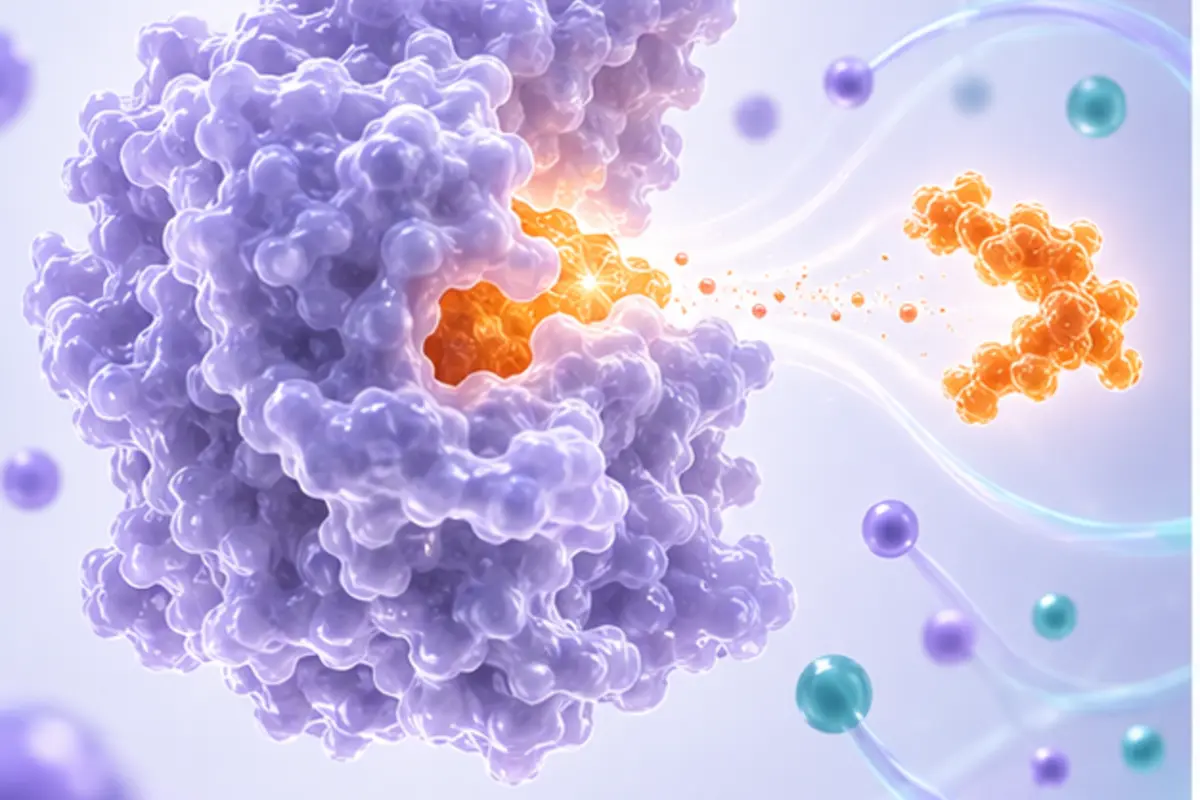
A modified growth-hormone fragment explored for fat metabolism and weight management, although a meaningful weight-loss benefit has not been established.
Fat metabolismBody compositionGH-fragment biology
Studied in hundreds of people; obesity efficacy was not establishedAOD-9604 progressed through oral and intravenous human studies. The largest obesity programme did not produce significant weight loss versus placebo, making the difference between biological plausibility and demonstrated benefit especially important.
Explore AOD-9604
WHY PEOPLE ARE INTERESTED
Why does AOD-9604 still attract interest?
The attraction is easy to understand: isolate a growth-hormone fragment associated with fat metabolism without recreating the whole hormone. That hypothesis produced real human trials, but the clinical weight-loss result was disappointing.
Start with the big picture
These cards show what AOD-9604 is best known for and where the interest comes from. When you want the detail, open Research for the studies or Evidence for a quick view of how strong the support is.
The main reasons this compound attracts attention. The Research and Evidence sections give you the deeper scientific picture.
Fat-metabolism hypothesis
Laboratory and animal work linked the fragment with lipolysis and reduced fat accumulation.
WHAT THE RESEARCH SAYS
This provides a plausible mechanism, but a laboratory fat-metabolism signal is not proof of meaningful human fat loss.
Evidence so farStrong preclinical rationale
Body-composition goals
Community use focuses on fat loss while trying to preserve training and lean tissue.
WHAT THE RESEARCH SAYS
The largest controlled obesity study did not find significant weight loss compared with placebo despite diet and exercise support.
Evidence so farHuman efficacy not established
Selective GH-fragment biology
AOD-9604 was designed from amino acids 176–191 of human growth hormone with an added N-terminal tyrosine.
WHAT THE RESEARCH SAYS
Human safety summaries did not show the IGF-1 pattern expected from full growth hormone, but that distinction does not create proven efficacy.
Evidence so farHuman exposure + mechanistic evidence
A valuable trial case study
AOD-9604 shows why an appealing mechanism must survive dose-ranging and placebo-controlled testing.
WHAT THE RESEARCH SAYS
Most identified obesity studies were negative, and development for obesity was terminated after the phase IIb programme.
Evidence so farSubstantial but negative human programme
Interest first. Evidence next.We start with why people are talking about AOD-9604, then show what the research actually supports so you can see the full picture.
HOW TO READ THE RESEARCH STORY
A plausible fat-metabolism fragment tested by an unsuccessful obesity programme
AOD-9604 reached controlled human dose-ranging studies. That makes the negative phase IIb result essential evidence rather than a footnote to the preclinical mechanism.
GH 176–191
01GH fragment
Modified 176–191 region without full GH signalling
→
02Lipolysis models
Cell and animal fat-metabolism rationale
→
03Human trials
Oral and intravenous exposure in hundreds
→
04Efficacy result
No significant weight loss in pivotal phase IIb
WHAT THE HUMAN PROGRAMME TESTED
A selective fat-metabolism hypothesis that did not translate into weight loss
AOD-9604 moved from GH-fragment and lipolysis biology into oral and intravenous obesity trials. The decisive lesson is that human exposure was feasible, but the central clinical claim was not confirmed.
01
Fragment design
The molecule uses the 176–191 region of human growth hormone with an added N-terminal tyrosine.
02
Preclinical signal
Cell and animal models support lipolysis and reduced fat-accumulation hypotheses.
03
Human test
The 24-week OPTIONS programme enrolled 536 adults and paired treatment with supervised diet and exercise.
04
Clinical boundary
No significant weight-loss advantage was demonstrated, and no human subcutaneous efficacy programme validates today's popular route.
RESEARCH LANDSCAPEGH fragment · lipolysis · failed phase IIb
Fat metabolismOral trialsBody weightRoute gap
Studies & trials
Studies & trials
Original publication · PubMed · trial registry where available
2005 · Randomized placebo-controlled phase II study · abstract-level reporting
Several controlled studies exposed hundreds of people to oral or intravenous AOD-9604.
✓
Clinical efficacyEarly
1/5 evidence depth
The pivotal obesity programme failed to demonstrate significant weight loss versus placebo.
◇
Safety evidenceDeveloping
3/5 evidence depth
Short-to-medium-term trial safety data exist, but injectable community use, immunogenicity and long-term product-specific safety remain uncertain.
⌁
Preclinical evidenceStrong
4/5 evidence depth
Animal and laboratory studies support fat-metabolism and tissue hypotheses.
HOW TO READ THESE SCORESStrong preclinical evidence · strong human evidence
These are editorial evidence-depth ratings on a 1–5 scale, not a statistical result or a single scientific formula. They summarise how much relevant evidence is present in each separate category and how mature that evidence is.
Human evidenceHow much direct research in people is available and how developed it is.
Clinical efficacyWhether human studies demonstrate meaningful outcomes for the claims being discussed.
Safety evidenceHow much human safety, tolerability and longer-term follow-up information is available.
Preclinical evidenceThe depth of laboratory and animal research supporting biological plausibility.
Multiple studies and a 24-week phase IIb programme
Obesity efficacyNegative
Largest controlled study did not beat placebo
Main gapInjected route
No validated subcutaneous efficacy or dose conversion
Keep route, study setting and outcome together
A measured biological response can be valuable evidence without establishing a self-administered protocol or a durable treatment benefit.
From promising signals to human evidencePreclinical research can reveal promising biological signals. Human studies show how far those signals have translated into real-world outcomes.
What people are exploring
PEOPLE & EXPERIENCE
Why people are exploring AOD-9604
Fat loss, body recomposition and a perceived non-growth GH alternative—mapped against a substantial human programme that did not establish obesity efficacy.
Community goals · human trial result · injected-route gap
Why this matters
AOD-9604 is explored mainly for fat loss, stubborn body-fat areas and a perceived 'non-growth' alternative to full growth hormone. The large human programme is highly relevant because it tested the central claim and did not confirm a meaningful obesity benefit.
Experiences can reveal recurring goals, perceived changes and practical questions that formal studies may not yet address. They can suggest what deserves investigation, but cannot isolate the effect of one compound from rehabilitation, time or other changes.
+
⌁WHAT RESEARCH ADDSScientific context
Human and preclinical research helps test whether an idea is biologically plausible, whether it appears in people and how confidently the result can be separated from chance, bias or other parts of recovery.
01Frequently discussed
Frequently discussedPositive interest with important uncertainty
Stubborn-fat reduction
Users commonly pair daily use with a calorie deficit and increased activity, making attribution difficult.
HUMAN EVIDENCE
The largest 24-week controlled trial found no significant weight loss versus placebo.
Community rationale only; review the established plan before adding uncertainty.
◇
Experience can start the question. Research has to test it.
Community reports can surface patterns worth exploring. Controlled human research is what tests whether those patterns are reliable, clinically meaningful and attributable toAOD-9604, while the available studies show how far that question has already been answered.
Dose & duration
DOSE & DURATION
See the numbers in their proper context
Compare published study protocols with the patterns people discuss in the community. The two are intentionally kept separate so an anecdotal routine is never mistaken for clinical guidance.
Research protocols · community patterns · calculator tools
Research dose ≠ recommendation. A dose used in a study describes that study only and does not establish an appropriate dose for an individual outside the research setting.
ONE ANECDOTAL COMMUNITY EXAMPLE
A flat daily community pattern—not a successful trial dose
The example below reflects recurring subcutaneous community discussion. Human obesity trials used oral or intravenous AOD-9604 and did not validate this route or a fat-loss result.
ANECDOTAL · UNVALIDATED
1Week 1
250 mcg · once daily
Anecdotal starting amount
2Weeks 2–4
250–300 mcg / day
Optional small community-described step
3Weeks 5–8
Continue only if reviewed
No evidence-based escalation
4After 8–12 weeks
Stop & reassess
No validated repeat-cycle interval
What people commonly discuss250–300 mcg subcutaneously once daily for roughly 8–12 weeks, usually alongside diet and training.
What remains unvalidatedNo human study validates subcutaneous bioavailability, this flat amount, a titration, meaningful fat loss or the proposed cycle and break.
◎
ROUTE & DELIVERYThe pivotal human study used oral dosing
OPTIONS tested 0.25–1 mg oral doses for 24 weeks and did not show significant weight loss. Oral milligrams cannot validate injected micrograms.
PROFESSIONAL SOURCE CONTEXT
The source shows what has actually been studied. It does not validate the community example above or turn it into guidance.
No significant weight-loss effect was established in this very small study.
↗
HOW TO READ THE STEP-UPThe start and target come from the published protocol.
The visual shows the opening amount, target amount and total study window. It does not invent intermediate steps: the linked paper or authorised product information remains the source for the complete escalation schedule.
COMMUNITY DISCUSSION
What people commonly discuss
Anecdotal / unvalidated · no human subcutaneous efficacy study
STARTING APPROACHES
Community protocol summaries commonly describe 250–300 mcg subcutaneously once daily, often without titration.
DURATION / CYCLES
Short 8–12-week cycles are frequently discussed alongside diet and resistance training.
MAINTENANCE DISCUSSION
A 4-week break is sometimes described, but no evidence-based washout, maintenance or repeat-cycle interval exists.
Community patterns are anecdotal and unvalidated unless a linked human study independently supports the same approach.
Often combined with
OFTEN COMBINED WITH
Why people explore pairings with AOD-9604
See the thinking behind community-named stacks, the different role each component is proposed to play, and how much of that idea has actually been tested as a combination.
Community rationale · component roles · evidence boundary
Potential first, evidence in context. Pairings are usually explored because their research stories appear complementary. That makes them interesting to study, but does not yet prove extra benefit or safety.
CURRENT COMPOUNDAOD-9604
→
OFTEN EXPLORED WITHAOD-9604 + structured lifestyle programme
AOD-9604 + Nutrition and resistance training
→
OFTEN EXPLORED WITHAOD-9604 + GLP-1 clinical care
AOD-9604 + Prescribed incretin therapy
→
OFTEN EXPLORED WITHAOD-9604 + GH-axis peptides
AOD-9604 + CJC-1295 / Ipamorelin
Combination-specific human research is the strongest evidence for what a pairing adds. Evidence for either ingredient alone should not be silently transferred to the combination.
AAOD-9604 IS USUALLY DISCUSSED AROUNDA selective fat-metabolism hypothesis with failed obesity efficacy
AOD-9604's largest controlled programme did not produce significant weight loss despite supervised diet and exercise.
+
PTHE PAIRED APPROACH MAY ADDEstablished body-composition foundations or modern clinical treatment
Training, nutrition and indicated obesity medicines have their own evidence; no study proves that AOD-9604 adds to them.
Nutrition, activity, sleep and indicated clinical care should remain visible rather than being credited to the peptide.
02Do not rescue a negative trial by stacking
A second compound cannot turn an unconfirmed AOD-9604 effect into evidence.
03Track body composition honestly
Weight, waist, strength and dietary adherence are more informative together than scale changes alone.
Safety context
◇
SAFETY & UNCERTAINTY
Human exposure exists, but the popular injected route was not the tested obesity route
01ENCOURAGING CONTEXTHundreds of people received AOD-9604 in trials
Oral and intravenous studies provide more direct human exposure information than a purely preclinical peptide profile.
02THE IMPORTANT BOUNDARYThe pivotal efficacy result was negative
Most identified obesity studies failed to show benefit, and development for obesity stopped after the phase IIb programme.
03WHAT REMAINS UNKNOWNPopular subcutaneous use and compounded-product risk
Human subcutaneous pharmacokinetics, immunogenicity, impurity exposure, aggregation and long-term repeat-cycle safety are not established.
What the current evidence saysFDA's review highlighted uncertainty around subcutaneous exposure, immunogenicity, peptide aggregation, impurities and compounded-product quality. The failed efficacy programme also changes the risk–benefit balance: uncertain benefit makes avoidable product and injection risk harder to justify.
01 · OBSERVEDPublished safety findings
The summary above reflects the human or preclinical evidence currently represented on this profile.
02 · UNCERTAINGaps still matter
Limited follow-up, small studies or absent controlled trials can leave uncommon and longer-term risks unresolved.
03 · CONTEXTProduct and regulatory status
Route, product identity, quality and regulatory status can materially change the safety context; see the linked status sources below.
ROUTEDo not convert oral milligrams to injected micrograms
Different delivery routes have different absorption and exposure; the popular injected pattern was not the pivotal trial route.
PRODUCT QUALITYIdentity and sterility matter
Unapproved injectable products add contamination, concentration and degradation risks independent of the peptide theory.
RISK–BENEFITA failed efficacy programme changes the calculation
When expected benefit is uncertain, injection and product risks carry proportionally more weight.