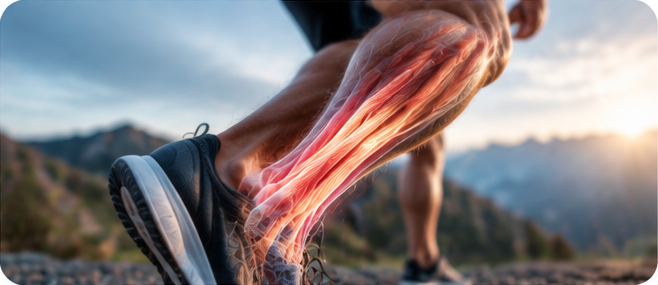
TB-500 attracts interest around recovery, wound healing and the repair of tendons, ligaments and other soft tissues, although research remains largely preclinical.
Tissue repairTendon & ligamentAngiogenesis
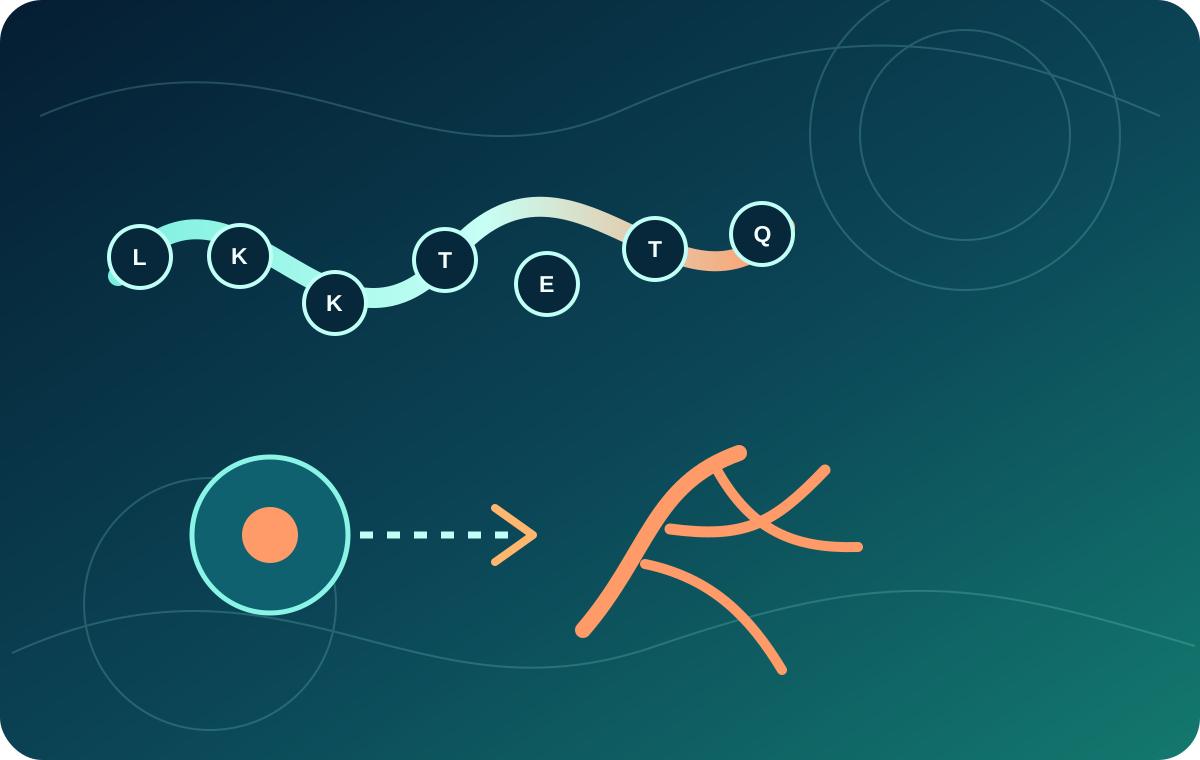
Promising biological rationaleThe LKKTETQ actin-binding motif has preclinical support for cell migration and angiogenic activity. Direct human TB-500 evidence remains very limited, so related thymosin-beta-4 research is shown separately.
Explore TB-500
WHY PEOPLE ARE INTERESTED
Why are people interested in TB-500?
Interest centres on regenerative biology: cell migration, vessel formation, wound repair and connective-tissue recovery. Much of the positive signal comes from thymosin β4 or its actin-binding motif rather than direct clinical testing of TB-500.
Start with the big picture
These cards show what TB-500 is best known for and where the interest comes from. When you want the detail, open Research for the studies or Evidence for a quick view of how strong the support is.
The main reasons this compound attracts attention. The Research and Evidence sections give you the deeper scientific picture.
Tissue repair & wound healing
Repair biology is the main reason TB-500 attracts attention, particularly where tissue recovery is slow or incomplete.
WHAT THE RESEARCH SAYS
Thymosin β4 and its active-site sequences have shown effects on wound repair, cell migration and regenerative pathways in experimental models. Direct TB-500 evidence is much thinner.
Evidence so farPromising related-peptide evidence
Tendon & ligament recovery interest
TB-500 is widely discussed around tendon, ligament and soft-tissue recovery, making connective tissue one of its strongest areas of community interest.
WHAT THE RESEARCH SAYS
The biological rationale comes mainly from thymosin-β4 repair biology and actin-dependent cell movement rather than controlled human TB-500 injury trials.
Evidence so farPreclinical rationale
Cell migration & actin biology
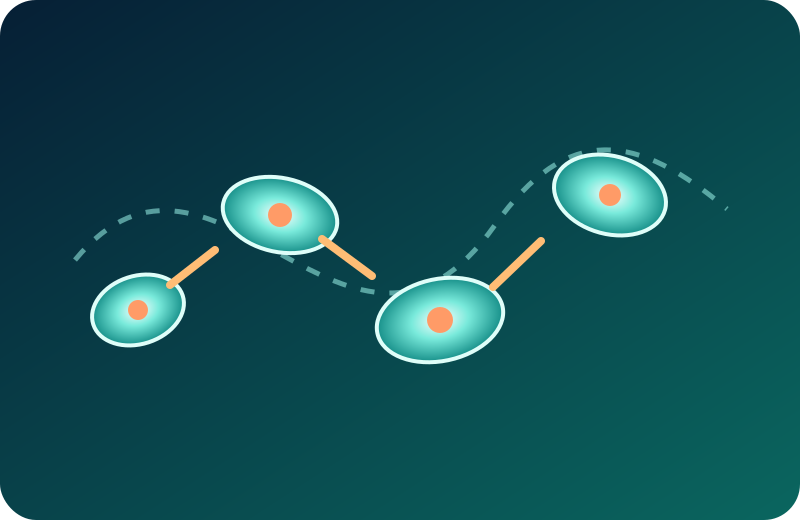
The short LKKTETQ sequence is especially interesting because it sits within the actin-binding region of thymosin β4.
WHAT THE RESEARCH SAYS
Experimental research has linked this motif with actin-related biology, endothelial migration and other cellular processes involved in repair.
Evidence so farMechanistic evidence
Angiogenesis & vascular response
Formation of new microvessels is an important part of tissue repair and is one of the more compelling biological themes around the thymosin-β4 pathway.
WHAT THE RESEARCH SAYS
A 2003 study found that a short actin-binding sequence containing LKKTETQ promoted endothelial migration, tubule formation and aortic-ring sprouting in experimental assays.
Evidence so farStrong motif-level preclinical signal
Inflammation & the repair environment
Recovery depends on more than rebuilding tissue; the local inflammatory and cellular environment also shapes the repair process.
WHAT THE RESEARCH SAYS
Full-length thymosin β4 has been studied for anti-inflammatory and tissue-protective activity. How fully those effects carry across to TB-500 remains unresolved.
Evidence so farRelated parent-peptide evidence
Broader recovery potential
The combination of cell-migration, vascular and repair biology gives TB-500 a broad recovery story that continues to drive research and community interest.
WHAT THE RESEARCH SAYS
Direct studies of TB-500 itself remain limited, but the surrounding thymosin-β4 literature provides several biologically plausible pathways worth investigating further.
Evidence so farEarly exploratory evidence
Interest first. Evidence next.We start with why people are talking about TB-500, then show what the research actually supports so you can see the full picture.
WHAT RESEARCH IS EXPLORING
A fragment built around a repair-related actin-binding motif
TB-500 is the acetylated 17–23 fragment of thymosin β4. Research around this sequence focuses on cell migration, angiogenesis and repair biology, while direct clinical studies of the fragment remain limited.
01Actin-binding motifLKKTETQ sits within the central actin-related region of thymosin β4.
02Cell migrationEndothelial and fibroblast movement is central to tissue repair.
03AngiogenesisRelated active-site research has reported vessel-formation signals.
04Tissue repairWound and connective-tissue biology explain much of the interest.
Why this still mattersRelated thymosin-β4 and motif research provide a credible biological rationale; direct TB-500 studies show how much of that promise translates to the fragment itself.
EVIDENCE SNAPSHOT
Evidence snapshot
◎
Human evidenceEarly
1/5 evidence depth
✓
Clinical efficacyEarly
1/5 evidence depth
This score reflects completed human outcome evidence. A registered or recruiting trial does not count until results are reported.
◇
Safety evidenceEarly
1/5 evidence depth
⌁
Preclinical evidenceDeveloping
3/5 evidence depth
HOW TO READ THESE SCORESDeveloping preclinical evidence · early human evidence
These are editorial evidence-depth ratings on a 1–5 scale, not a statistical result or a single scientific formula. They summarise how much relevant evidence is present in each separate category and how mature that evidence is.
Human evidenceHow much direct research in people is available and how developed it is.
Clinical efficacyWhether human studies demonstrate meaningful outcomes for the claims being discussed.
Safety evidenceHow much human safety, tolerability and longer-term follow-up information is available.
Preclinical evidenceThe depth of laboratory and animal research supporting biological plausibility.
Promising biological signals are visible in preclinical and related peptide research, while direct human TB-500 evidence remains early.
PEOPLE & EXPERIENCE
What people are exploring
Recurring themes from peptide and wellness communities, shown alongside what published research currently suggests.
Experience + research context
Why this matters
Community interest in TB-500 is concentrated around injury recovery, tendons and ligaments, return to training and pairing it with BPC-157. Those experiences help identify the questions people care about most, while direct human TB-500 research remains limited.
◎WHAT PEOPLE REPORTReal-world interest
Experiences can reveal recurring goals, perceived changes and practical questions that formal studies may not yet address. They can suggest what deserves investigation, but cannot isolate the effect of one compound from rehabilitation, time or other changes.
+
⌁WHAT RESEARCH ADDSScientific context
Human and preclinical research helps test whether an idea is biologically plausible, whether it appears in people and how confidently the result can be separated from chance, bias or other parts of recovery.
Very frequently discussedMostly positive
Faster tendon / ligament recovery
HUMAN RESEARCH
No direct controlled TB-500 efficacy trial identified
PRECLINICAL RESEARCH
Related thymosin-β4 and actin-motif repair biology provides a plausible rationale
WHERE IT STANDS TODAY
A major area of community interest with relevant biological support, but direct TB-500 human evidence is still needed.
Frequently discussedMostly positive
Better soft-tissue recovery
HUMAN RESEARCH
Direct TB-500 evidence remains very limited
PRECLINICAL RESEARCH
Cell-migration and wound-repair pathways are supported in related experimental research
WHERE IT STANDS TODAY
The surrounding biology is encouraging enough to justify interest, while the fragment itself remains under-studied.
Commonly discussedPositive but mixed
Improved repair environment / less inflammation
HUMAN RESEARCH
Not established for TB-500
PRECLINICAL RESEARCH
Full-length thymosin β4 has anti-inflammatory and tissue-protective research
WHERE IT STANDS TODAY
Related parent-peptide findings are interesting, but they should not be treated as proof of the same effect from TB-500.
Very frequently discussedMostly positive
BPC-157 + TB-500 works well as the Wolverine Stack
HUMAN RESEARCH
No controlled combination trial identified
PRECLINICAL RESEARCH
Each component has a different surrounding research rationale
WHERE IT STANDS TODAY
One of the best-known recovery stacks in peptide communities; combination-specific research would be needed to quantify any added effect.
◇
Experience can start the question. Research has to test it.
Community reports can surface patterns worth exploring. Controlled human research is what tests whether those patterns are reliable, clinically meaningful and attributable toTB-500, while the available studies show how far that question has already been answered.
DOSE & DURATION
How dosing is being explored
Direct human dosing data are not established, so research context and commonly repeated community patterns are shown separately.
Research + community context
WHAT THE RESEARCH CAN TELL USNo validated human TB-500 dose or titration schedule has been established.
Direct TB-500 work is mainly laboratory and animal research. The figures below are therefore presented as anecdotal protocol patterns, not as a clinically validated regimen.
COMMONLY DISCUSSED PATTERNS
How community protocols are usually structured
Community-described only
01
LOADING PATTERN
Higher-frequency opening phase
Amount commonly cited
2–2.5 mg per dose
Frequency
Twice weekly
Approx. weekly total
4–5 mg/week
Typical discussion window
4–6 weeks
02
MAINTENANCE PATTERN
Lower-frequency continuation
Amount commonly cited
2–2.5 mg
Frequency
Once weekly or every other week
Typical discussion window
4–8 weeks
Evidence basis
Anecdotal / community practice
03
BREAK / REASSESS
Pause rather than continuous use
Amount
None
Commonly discussed break
4–8 weeks
Purpose
Reassess recovery and whether further use is being considered
Evidence basis
Community convention, not trial-defined
↗
WHAT ABOUT TITRATION?TB-500 does not have a trial-defined step-up titration schedule.
Community protocols more often describe a change of phase — a higher-frequency loading period followed by a lower-frequency maintenance period — rather than gradually increasing the dose week by week. Where a compound does have trial-defined titration, future pages will show the step-up schedule explicitly.
WORK WITH THE NUMBERS
Calculator tools
Translate a figure you are reviewing into vial, liquid-volume and syringe calculations without treating the example as a recommendation.
Important context: the figures above summarise commonly repeated public/community protocols. They are not established human dosing instructions and have not been validated in a controlled TB-500 trial.
Often combined with
OFTEN COMBINED WITH
Why people explore pairings with TB-500
See the thinking behind community-named stacks, the different role each component is proposed to play, and how much of that idea has actually been tested as a combination.
Community rationale · component roles · evidence boundary
Potential first, evidence in context. Pairings are usually explored because their research stories appear complementary. That makes them interesting to study, but does not yet prove extra benefit or safety.
CURRENT COMPOUNDTB-500
→
COMMUNITY STACKWolverine Stack
BPC-157 + TB-500
Combination-specific human research is the strongest evidence for what a pairing adds. Evidence for either ingredient alone should not be silently transferred to the combination.
TB-500 has a plausible biological rationale, but the direct human safety database is much thinner than the related thymosin-β4 literature.
CURRENT EVIDENCE POSITIONDirect human TB-500 data remain sparse
INVESTIGATIONAL
H
Human exposure data
Very limited
FDA's current review says it has not identified human exposure data for drug products containing the thymosin β4 fragment known as TB-500.
Q
Product quality matters
Important
Peptide aggregation, impurities, formulation and manufacturing quality can influence the behaviour and immunogenicity of an injectable peptide product.
ID
Fragment vs parent peptide
Keep separate
Safety or efficacy findings for full-length thymosin β4 should not automatically be assigned to the shorter acetylated TB-500 fragment.
S
Competitive sport
Prohibited
Thymosin β4 and TB-500 are prohibited in sport under the World Anti-Doping Code growth-factor category.
FDA says it has not identified human exposure data for drug products containing the thymosin beta-4 fragment known as TB-500 and has highlighted potential immunogenicity, aggregation and peptide-impurity concerns.